The rise of Meat Proxies (and how to disarm them)

Photo by Didier VEILLON / Unsplash
I've noticed a trend that's on the rise, lately, especially around contract negotiations of all sorts (NDAs, SLAs, DPAs, etc.), whereby one or both (human) parties just sends the output of his/their respective AI tools to the other one, and viceversa. In doing so, their contribution to the discussion is null or even negative. Instead of removing friction, they're adding unnecessary steps, clauses and verbosity that make the discussion drag along for much more than it's necessary.
The people in the middle are meat proxies, as seemingly coined by Niklas Gruhn in this article, and this term couldn't be more graphical and explicit.
Put simply:
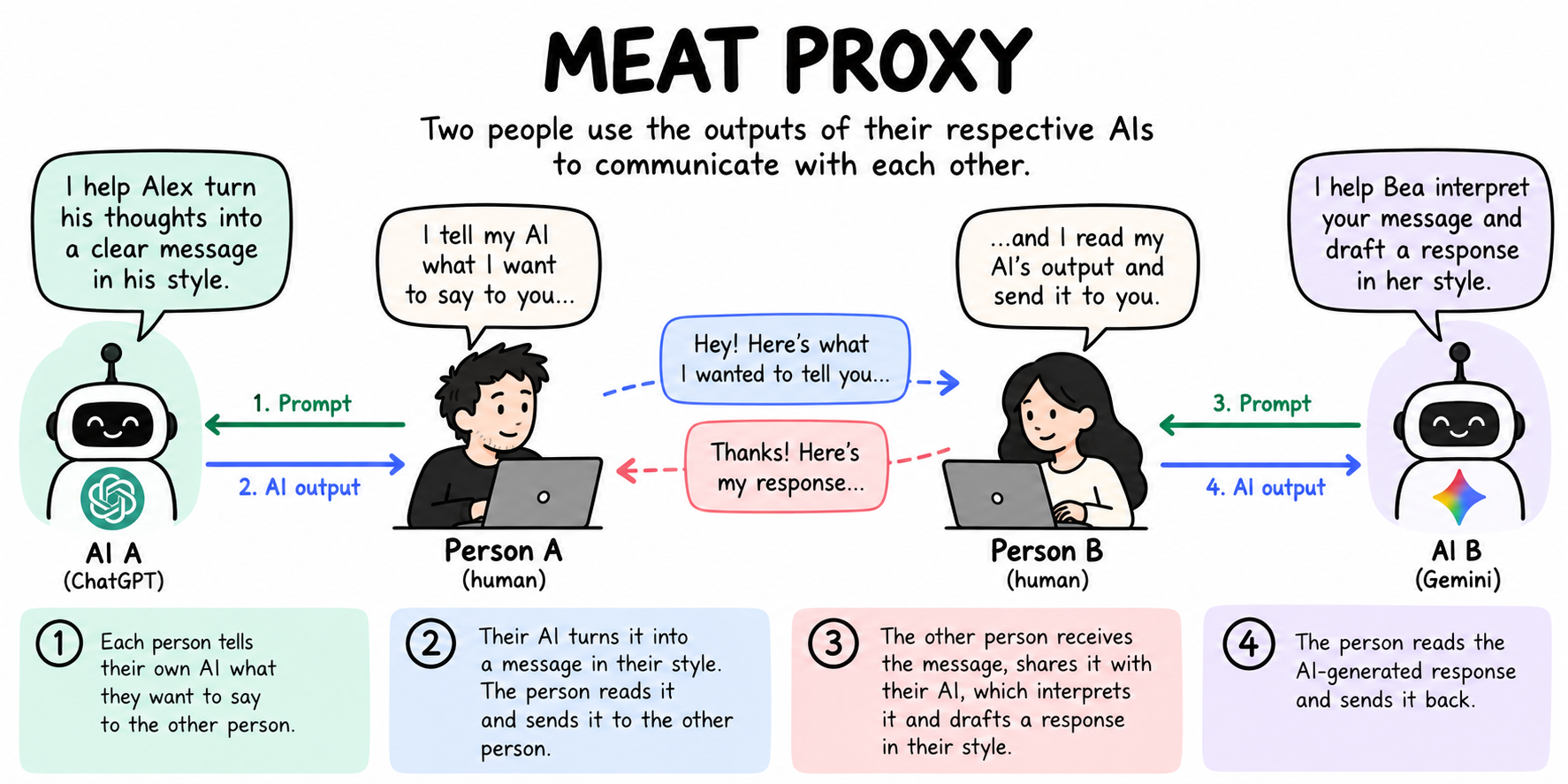
I've had enough interactions with meat proxies lately that I'm forced to write this post about how to spot them and how to steer them in the right direction when facing them.
First, how to spot them. This is pretty straightforward: spotless & flawless writing, long bullet points, perfect formatting and extreme discipline in listing all the action items, decisions and past agreements in every email they send. Every email sounds mechanical, automated and artificial. It's all three at once.
Being a meat proxy isn't about using AI. It's about delegating judgment to AI.
To be clear, I don't think using AI to draft an email or review a contract makes you a meat proxy. I do it myself most of the time. The difference is whether you've read, understood and validated what you're sending. If you can't defend your own position without consulting ChatGPT, you're not negotiating: you're forwarding messages between two machines.
If they write, enumerate, argue and sound like ChatGPT, most likely it's because it fucking is ChatGPT.
For instance:
- They introduce new objections that weren't mentioned in previous discussions, without explaining why.
- They contradict positions they previously agreed to.
- They keep proposing increasingly detailed clauses without establishing what business risk they're addressing.
- They cannot explain why a particular provision is important to them when challenged.
- They reopen settled issues after each round of review.
Also, LLMs tend to be maximalists when they're not instructed to have any sort of cap. For instance, if I ask Claude to generate an NDA to "fully protect me from the wrongdoings of working with an external agency" it will go to the most extreme scenario. If you had limited its scope to generate an NDA "for a maintenance project of 6 months and 12.000 euros, with an offshore external agency in Austria", it will narrow it down to a more realistic draft. The document itself - if it's a maximalist request - is also a big tell of the meat proxy on the other side.
Now, that's only part of the problem. Tools like ChatGPT, Perplexity, Claude and the like are incentivised to keep the conversation going. They will always offer to do something else so you just hit tab and prompt them further. Say the word.
AI doesn't know when enough is enough unless you tell it what enough looks like. If you keep asking it to find flaws in a contract, it will keep finding them. And because every suggested change sounds reasonable in isolation, you end up negotiating things that don't matter. Congratulations, you've just spent another week - and thousands of tokens - discussing a 12.000 euros contract!
Brought to the email exchange I referred to earlier, every time you input your counterparty's reply to your AI tool, it'll always find something to correct, polish or fine-tune. It's extremely unlikely that it'll want to wrap up. Hallucinations discounted, there's always something that could be marginally improved because you don't perceive the diminishing returns of this interaction exchange. You're probably busy juggling 10 other plates. And, last but not least, the sunken cost of having invested so many exchanges make you want to go for yet another round.
Now, how to disarm them. This is where it gets interesting.
Once you have spotted a meat proxy on the other side of the negotiation, you have to steer them back into human-only territory:
- If possible, have them meet in person.
- If not, an online meeting will do. Most people aren't fast enough to type&read in real time using an AI tool.
Oftentimes, during said meeting, if you confront them about a specific clause or wording, they won't have a clue or won't be able to defend their stance and you will be able to bag home certain wins, if not all.
In my experience, every time I've had 2-3 rounds of meat proxying, a single call has ended the discussion to my advantage.
Of course, there's a caveat to all of this: you have to know your part. If you're discussing about something outside of your knowledge, you're just another meat proxy yourself.
I have personally read and written hundreds of contracts for MarsBased: service agreements, proposals, NDAs, maintenance contracts, etc. While I don't know all of the possible outcomes or scenarios, I have a good idea of whether a clause is good or bad for us or what ranges could we accept in a discussion about numbers of warranty periods, payment terms, liability caps, etc.
Another less efficient tactic, but still valid, is to ask something that happened offline (if it has happened). Something brought up in a previous meeting like "in our last meeting at your offices, you mentioned being wary about your current provider doing X, but this document doesn't reflect that". This will force them to write it themselves, or at least force a bit more effort into giving their Claude more context.
Anyways, I hope that you haven't had to suffer this too often, but it's a (sad) trend and it will only get worse... before it gets better.
I am not criticising AI - on the contrary! I think we have to get through these sloppy times where we're all learning the new social contracts, but there'll always be subtle - and not-so-subtle - tells of inexperience signalling that you're a rookie.
AI is making it increasingly easy to sound like an expert in virtually anything. Unfortunately, smartasses will always remain smartasses. They're just getting more difficult to spot, nowadays.
The irony of all of this is that AI was supposed to remove the human bottleneck from these processes. Instead, we've turned ourselves into the bottleneck, mindlessly copying and pasting between two machines that could otherwise talk to each other.
At that point, what exactly are we contributing?