Eleven years investing in startups: what I got wrong, what I got lucky with, and what I'd tell myself in 2015

There is a check I wrote in 2015 that I still think about: One thousand euros, my entire liquid savings at the time. I was one year into creating MarsBased and my salary wasn't anything to write home about, but a good friend told me about investing in startups with small amounts of money just to get started, and dispelled a few doubts I had.
Investing in startups is like getting a tattoo or trying drugs: it's always through a friend that tells you that it's safer than you think, more accessible than it looks like and shows you that it's also pretty affordable (at the beginning, at least).
He had been given great returns in a couple of investments - he was one of the first investors in Kantox - so I wired them into the new Kantox round, at a much higher valuation than he had joined a few years back. I had no thesis, no portfolio theory, no due diligence process, no financial background and no idea about investing or personal finance whatsoever. I barely understood the rules of the game. Being entirely honest, I didn't.
Contrary to what I usually do with 99% of the things in life, where I usually over-analyse things and end up not moving forward (analysis paralysis), I decided to give it a go blindly and I YOLO'd my first small angel investment through a pledge fund that allowed small checks by virtue of syndication and expensive fees.
Seven years later, BNP Paribas acquired Kantox for €120 million.
I tell this story not to claim the win because on a thousand euros my return was symbolic, not life-changing, and it came almost eight years later, smaller than some of the checks I write nowadays.
In fact, another quick anecdote here: a friend of mine scored a whopping 25x return on his first angel investment and then burnt it all in 15 investments that went down the shitter in matter of five years only. Now, that's a hard lesson!
This is the post I wish I had read in 2015. I've now invested in about 40 companies as an angel investor and I've been a partner in the first Itnig fund for about five years now. I've seen startups die a sudden death, one that gives dividends now, lots of amazing deals I passed on (a couple went on to IPO), and most of the rest sit in the ambiguous middle: alive at times, pivoting others, building something that looks nothing like what I originally backed and oscillating every day between barely surviving on ramen profitability and about to close down.
What follows is an honest confession. A long one, so bear with me.
Eating scraps for five years
Nobody tells you this at the beginning: your first three to five years as an angel investor will be mediocre, and there is essentially nothing you can do to shortcut it.
You will overpay for deals nobody else wants. You get the leftovers. The breadcrumbs on the table where everyone else has eaten but you weren't invited to. You will invest in founders you like as people when the business doesn't deserve capital because you haven't learnt to say no. You will say yes to sectors you find personally exciting even when you have no edge there and know nothing about. You will do all of this because you don't yet have pattern recognition, and pattern recognition is built almost entirely from volume: volume of deals seen, deals passed on, monthly reports read, founders met, cap tables read, follow-on rounds observed and failures watched up close. And lots and lots of misunderstandings.
The problem is structural: the glass ceiling on early-stage investing is two-fold: first, the feedback loop is brutally slow. A seed investment takes seven to ten years to resolve. That means the lesson I should have learned from a bad 2016 deal might not be visible until 2023 (or later, because Spanish startups tend to die longer deaths than in other countries). By the time the feedback arrives, I've already made twenty other decisions under the same wrong assumptions. You can't fail fast in angel investing the way you can in a startup unless you've got a shitload of money to deploy (not my case).
Second, as an angel investor you're never incentivised to share your dealflow outside of your circles, so there's little to no fresh blood in the angel circles. The good deals are oversubscribed and everyone wants to have fewer investors, not more. A rookie angel investor almost never brings any kind of value to the deal.
There is no path to graduate from rookie angel investor to senior angel investor other than writing lots of checks and enduring losses and years without returns in mediocre startups. Unless you're fucking rich, again and I'm sorry to reiterate, which is not my case.
Personally, I invested slowly in the first years (I barely count them) and went harder from 2019 onwards:
- 2015: 1 investment.
- 2016: 0 investments.
- 2017: 1 investment.
- 2018: 0 investments.
- 2019: 7 investments.
- Later on, 4-9 investments per year.
Therefore, even though my first check was written in 2015, it's safer to assume that my angel period started in 2019, so I am now in year seven, instead of eleven. Why do I say 11 years then? because I spent too much time over-analysing, reading tonnes of mediocre decks, tried to get on some good deals unsuccessfully and genuinely put in the work to try to become an investor, but I just couldn't!
What I found was that naiveté has a use: it makes you receptive and approachable. In my first years I was far more willing to believe in founders because I hadn't accumulated enough failure yet to be cynical. I passed on things I should have backed because they didn't fit a pattern I didn't yet have. I backed things I shouldn't have because they were exciting and the founder was charming and I was too early in the game to triangulate between the two. When people ask me if the early years were worth it, I tell them yes but not for the returns. They were worth it because of what they cost me in learnings, the reputation they built me (investors get more press and access to cool shit) and the network and doors the investor badge opened me.
Why do investors get VIP status and free food in conferences when they're the ones who least need it? 🤨
Paying to learn is not a metaphor. It is how early-stage investing works, sadly. Accept it as a feature, not a bug, and size your checks accordingly and you might spare yourself from seeing too many red numbers in your personal finance spreadsheet.
Biases are heavy crosses you can't see
I've been running MarsBased as a software consultancy since 2014, which gives me a specific, reproducible edge on early-stage investors. Founders come to me for development estimates before they raise money. That means I see the product before most investors do and can also help them to define how much they need to raise. It also means I'm systematically biased toward companies that have made it far enough in their thinking to need a development agency, which excludes a certain category of really early ideas.
Over the years, I have come to terms with my biases, though. Here are the main ones:
I over-index on B2B because I've lived in B2B my entire career. A company's B2C pitch often sounds unconvincing to me not because it's bad but because I lack the frame to evaluate it properly (and I got royally screwed with one, in particular). Over time I've learned to compensate by looking for the B2C companies that don't yet know they're going to end up selling to businesses; the ones where the end user is a consumer but the unit economics only work at B2B/enterprise scale. That's become a genuine sub-thesis and a pitch that gets many compliance smiles.
I over-index on founders I like as people. Liking the founder is not a thesis. It is a heuristic with a lot of false positives and a catastrophic false negative rate. The founders I have liked most over the years have not produced the best outcomes, except for one: Nacho González Barros (founder of Infojobs). I've invested in three of his companies.
I over-index on my ability to have an impact. When I understand the problem a startup is solving because I've lived it, I feel more confident in the investment. This is rational in one sense: I can do better due diligence in sectors I know, and spared me from investing in bullshit like NFTs, metaverse and blockchain, but it also means I've walked away from genuinely good companies in healthcare, climate, and logistics because I didn't feel like an expert. Being a non-expert is not the same as being unable to evaluate an opportunity. Also, I over-estimated my ability to help the company with my network or other skills because more often than not, they're more skilled than I am. I have over-patronised some of my portfolio companies with the "I'll bring in my smart money to the table". Duh.
The most dangerous bias of all is the social proof cascade. I have invested in companies primarily because people I respected were investing in them. I admit I have done a couple of deals where I was dragged into them out of sheer FOMO, especially at the start. Following conviction is your job as an angel investor. Following other people's conviction is a way to feel like you're doing the job without actually doing it. And this is perhaps my most honest confession of the entire article.
Dealflow quantity is a vanity metric
I receive roughly fifteen to twenty pitch decks a week. I actually read one or two, at most, if they're from someone I trust. Sometimes, I go for months without reviewing any pitch deck.
You get so little dealflow at the beginning that you put a lot of effort into making that number grow at the expense of quality. I'll figure out quality later. Wrong: too much noise is a burden and a tax to your time. Low-quality dealflow is like trying to drink from a firehose, and the most expensive opportunity cost you will encounter as an angel investor.
So, instead of optimising for dealflow quantity and then quality, just focus on quality. Life's too short to review mediocre pitch decks. There's nothing you can learn from them.
The filtering mechanism I've built over eleven years looks like this: if the opportunity comes from another angel I trust who has already invested, I look at it and I'll almost consider investing. If it comes from someone I trust who hasn't invested but is flagging it, I am passing on it. If it comes through any other channel (a LinkedIn message, a cold email, a platform, an introduction from someone I don't really know) I'll archive immediately and move on. Up until last year, I answered back to everyone out of courtesy, but this social contract is very outdated: it doesn't take into account that most of these efforts are automated, and secondly, we are not mentally wired to accept inputs from tens of thousands of people in such little time. It burns out your brain.
This filtering system is the product of a simple observation: the best founders don't find investors through cold outreach. They get to the right investors through warm channels because they are good enough (socially, professionally, reputationally) to have those channels. The absence of a warm introduction is not a disqualifier in theory. In practice, in my personal case, it works as one.
There is a piece of advice that took me years to acknowledge: the best dealflow comes from other investor-founders, not professional investors. When a founder you respect sends you a deal, you inherit some of their due diligence and their reputational skin in the game. When a founder you've never met, or a professional investor, sends you a cold deck, you have neither.
The corollary: be extremely selective about what you forward to others. For the first several years I was extremely promiscuous with deal forwards, passing along decks with minimal context, effectively using other people's time to process my dealflow for me.
In my defense, a lot of investors told me to send them whatever I got so they could filter themselves, but in reality, I just sent noise. The only deals worth forwarding to another investor are deals you have already invested in, are about to invest in, or are passing on for reasons specific to you rather than the company: a conflict of interest, a geography you can't support, a sector where you know nothing useful, a lack of liquidity. Everything else is noise with your name on it, and it degrades your credibility, reputation and personal brand over time.
Founding experience is a thesis, not a preference
The investment framework I've settled on is this: I fund technology companies in the B2B space, or companies that don't yet know they'll end up B2B, run by founders who have built a company before. I don't invest in first-time founders anymore.
My reason for it: I genuinely do not know how to evaluate first-time founders. I don't have the pattern recognition to separate the ones who'll adapt from the ones who'll chicken out when the first serious crisis hits. With a founder who has already built something - especially if it failed - I have evidence. I have references I can check and specific questions I can ask. We can share experiences about hard times I've had with my company and compare them to theirs. That's when I can really qualify someone.
The other part of it is impact. My checks are small: I've never gone above 10k € in a single investment (as an angel). At that size, what I'm offering is not capital but the credibility of having been through it, and the ability to be useful in the specific ways that a founder who has built a business can be useful to another founder who is building one. That's the concept I call FIF (Founders Investing in Founders). It's the only kind of smart money I've seen consistently deliver value, and I'll defend that view against anyone who wants to argue. I won't fist-fight over it, but we can argue.
The version of angel investing that doesn't work is: a person who has never operated a company, writes a 2k check, and then demands board updates, co-investor approval rights, and regular access to the CEO's time. I've watched this pattern damage early-stage companies. It costs founders mental bandwidth at the moment they can least afford to spend it. Those 2k have never been so expensive. 2k tonnes of ego, instead of 2k euro.
Pre-seed is an expensive numbers game
Every company in my portfolio has changed in ways I did not predict. Every. Single . One. Business model, market, customer profile, team composition, name, logo, founding team, etc. This is one of the hardest things for me as an angel investor: the initial pitch deck is nothing but a snapshot of where they are right now, but you're to assess the potentiality of what they can become.
Example: When Cledara pitched me early on, they were creating virtual debit cards for companies to pay AWS. I thought they could expand to do that for other cloud vendors and to even all SaaS, but I didn't predict their pivot to being able a full-fledged SaaS monitor for spending, governance & more. I would've invested in their final incarnation, but I wasn't able to predict this. They're going to be one of my strongest anti-portfolio heroes and I'm happy for them because they're some of the coolest and most down-to-earth people I've ever met.
This is what pre-seed investing actually looks like: you are not investing in a company but in the initial conditions of a company and betting that at least one of twenty thousand things they could do will turn out to matter. The pitch deck has never been more irrelevant to me, to the point that I almost ignore them entirely.
The corollary here is that auditing early-stage companies like they're Series C rounds is a waste of everyone's time. I've watched angels with tiny checks run two-month-long due diligence processes on pre-revenue seed rounds. The information asymmetry at that stage makes angel investing look like gambling. In fact, if you've read A Random Walk Down Wall Street: The Time-Tested Strategy for Successful Investing, I'm increasingly more convinced that a group of monkeys, throwing darts at a wall with some startup logos, would pick a portfolio with better returns than most angels & early-stage VCs out there.
There's a way to reduce uncertainty, ever so slightly: I invest in founders who already have sales. Not traction in the abstract, not ARR projections, not letters of intent but actual paying customers who are giving them actual money in exchange for actual value. That filter removes a large portion of the deals I see and it has saved me from a large portion of the disasters I would otherwise have had, especially in my B2C investments.
On the other hand, this filter can bias me towards small amounts of revenue that can hit a wall or prove to be insufficient in the long-run, instead of betting for a little more of no-revenue experimentation that results in a better business model later on. I'll take the trade-off.
The cap table is not a trophy shelf
One thing I've learned from being on the unsolicited receiving end of advice as a founder is that most investors don't add the value they think they do. Not because they're not smart or well-intentioned or have the experience but because they're just dropping in casually, from time to time, and they lack context. The cringe-worthy "let me know how can I be helpful/add value".
If there's one thing I do well as an investor is that I refrain from giving advice ever to my portfolio companies unless I know them very well or I have asked them millions of questions before I venture in counseling.
The framework I've developed for thinking about co-investors, and that I'd recommend any founder use when evaluating the people they're bringing onto their cap table, is simple: rate each investor across five dimensions:
- Sector expertise.
- Fundraising leverage.
- Brand and signalling value.
- Availability when things get hard.
- Network quality for the specific problem you're solving.
If someone scores well on at least three of those five, they're earning their place. If they score well on none of them, they're a Business BLANDgel: an investor who takes your call only when there's a liquidity event in sight and ignores you the rest of the time. Someone you probably shouldn't have invited in the first place, but you needed the money and felt forced to. A short-sighted commitment with a very expensive tax.
The uncomfortable truth for anyone who invests, myself included, is that founders are running this analysis on potential investors, if they know what they're doing (especially in second companies). They may not have a formal framework for it, but they know which investors they call when something goes wrong and which ones they don't bother and which one plays dirty tricks.
No wonder why some of the most-renowned Spanish angel investors, including a few bigmouths that appear in TV, radio and newspapers, only have first-time entrepreneurs in their portfolios. Once you've had them in your cap table, you learn the hard lesson and never call them again for future adventures.
I ask explicitly to see the cap table and whom they're talking to in their fundraising process. If I see certain names of individuals or certain VCs, I tell them I'm out. I can't do anything if they end up bringing them later on, but at least I tell them that if they ever bring someone from my blacklist, I'll ask them to buy me out, so at least I don't feel dirty by sharing cap table with gangsters or sexual harassers.
We all know who they are.
The class problem nobody wants to talk about
There is a conversation about diversity in the startup ecosystem that tends to focus on gender and ethnicity and mostly ignores class. I understand why: the others are more legible, more publicly measurable and infinitely more convenient in terms of PR and zeitgeist, but they'll never focus in the elephant in the room. Social class is the one that shapes the entire playing field in ways that nobody likes to think about because of the implications it'd have in society as a whole.
Being a bootstrapped investor with a run-of-the-mill working-class surname like Rodríguez, someone who has had to earn every euro they've put into a cap table - by selling pokémon cards on ebay, working cleaning hotels or as a bartender - is a different experience than being the kind of angel who can start shelling out 25k checks in their first year of investing. The Spanish ecosystem, like most European startup ecosystems, was built largely by people with capital, social capital, and safety nets that are not uniformly distributed. The uncomfortable truth is that everyone in the room has not access to the same starting conditions despite everyone selling the idea of it being a meritocracy.
From a private post I wrote a few months ago:
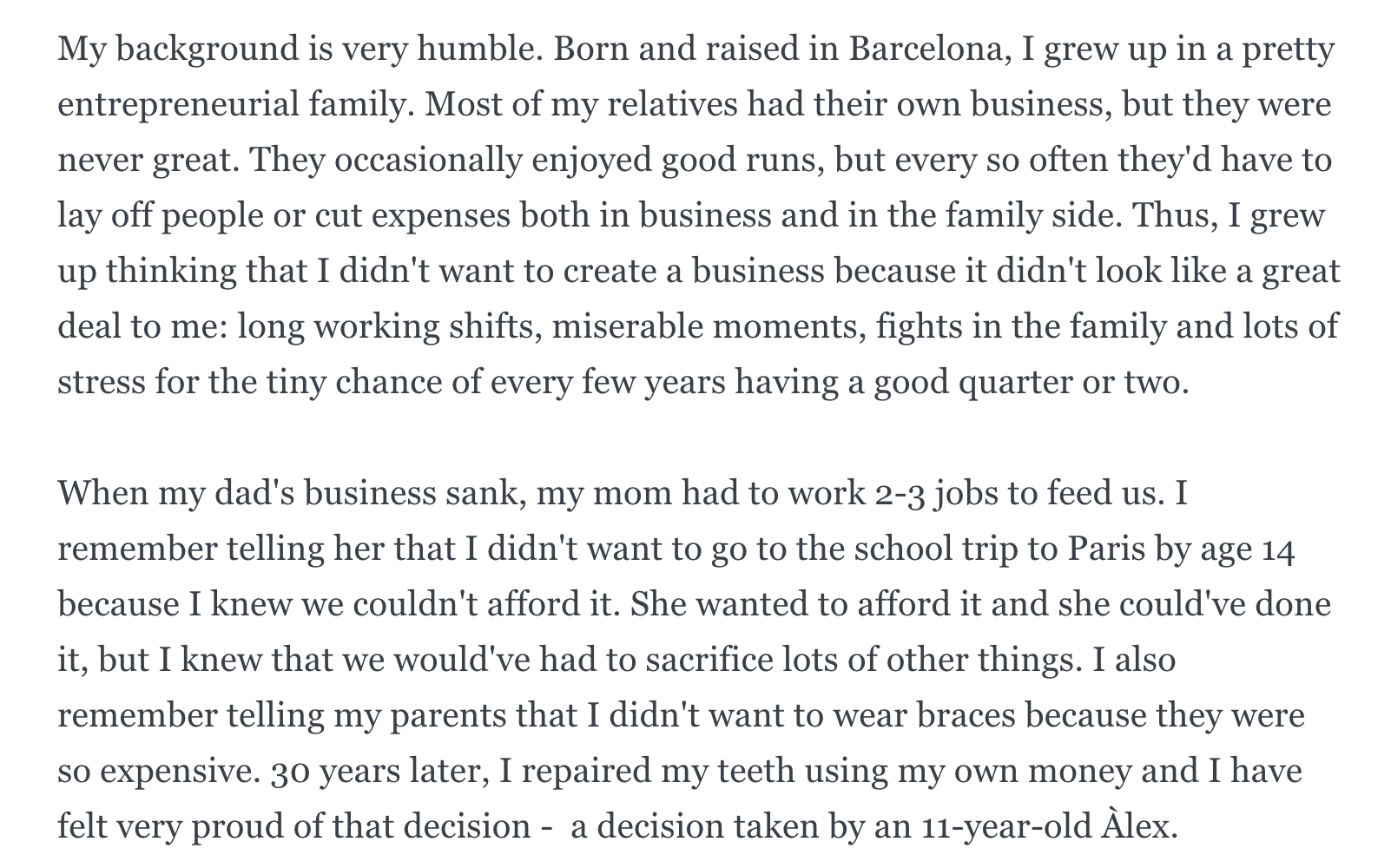
I didn't have it easy but I made it. I am one of the outliers that proves to be the exception to the rule. And the imposter syndrome that comes with navigating scenarios that were not built for you is real and piercing and doesn't go away just because you've had a few good experiences or you feel welcome. It's pure theatre.
I'm not raising this to appear vulnerable. I'm raising it because it affects the kinds of founders I'm able to recognise as worth backing: those coming from underprivileged backgrounds and environments of scarcity.
If the investment ecosystem defaults to class, status and social proof, the entrepreneurial ecosystem lacks pedigree and surnames - mostly. The ones who didn't have a safety net to fall back on when they started are often the ones who have built the most durable businesses, because they didn't have the luxury of learning through failure at someone else's expense.
And that, my friends, is yet another patronising example of social status gatekeeping: poor folks take real risks, rich folks speculate and tell you that they're also risking a lot. This condescending narrative is sickening.
What I'd tell 2015 me
Don't invest in startups. Put it all in ETFs and worry about other stuff*.
If you don't know anyone in the cap table, you probably shouldn't be there. Assuming you know your fair share of angel investors, of course. If you don't know angel investors, don't invest altogether.
Your checks will pay off dividends in many flavours, but the financial returns might not come very early. Some of my deals have earned me knowledge I have then used to have informed conversations about that sector with potential clients of MarsBased. Some others have earned me being invited to cool shit like joining itnig, SeedRocket, Masia.vc or even writing on Samuel Gil's Suma Positiva.
Only forward deals to other investors you'd invest in yourself. Your signal is the only currency you have that actually appreciates and will build your investor status more than the checks you write.
The investor relationship that matters is the one you build after you invest, not before. Commit to clear expectations with founders. I give them my whatsapp and tell them to bug me anytime. If they want closer commitments, I can explore them with only 2-3 at the same time, for a certain period of time, but not long-term. This is how I work at my best.
The best dealflow comes from other founders. People you respect that invite you to their FFF rounds. VCs and professional investors aren't invited there, so the upside is enormous. Spend more time building relationships with other founders than you spend building relationships with investors. I love founders investing in founders deals, invite-only, highly curated. There's real skin in the game there and a different kind of energy. They're also the highest in the risk department.
Exits are inconsequential unless you hit a home run. They're evidence that the market is sometimes kind to people who don't yet know what they're doing. Unless you can retire with a single exit, you're just playing slot machines that give you some bait so you keep playing longer.
Don't do down-rounds or bridge rounds or hail-mary rounds. They never pay off and they're also a very expensive opportunity cost. Invest on their way up, offer help on the way down. That's what experienced people do, and rookies do it the other way around. A small caveat: don't do follow-ons as angel investor. The signaling doesn't matter here and also you have to have very big pockets to make a difference.
It's been eleven years, about forty companies, one BNP acquisition that started with a thousand euros, another company (Mailsuite) who gives dividends now, a few undercover acquihires and too much fluff.
The title of the Suma Positiva piece I wrote a few years ago - the one that started most of the conversations that led to this post - was "A invertir se aprende invirtiendo". You learn to invest by investing. There is no shortcut.
The only way to develop judgment and callus in an asset class with ten-year feedback loops is to stay in long enough for the feedback to arrive.
* Just kidding - or not. Some of my best returns have been through Indexa Capital. Here's my affiliate link if you wanna try it out. I'm a happy customer.